

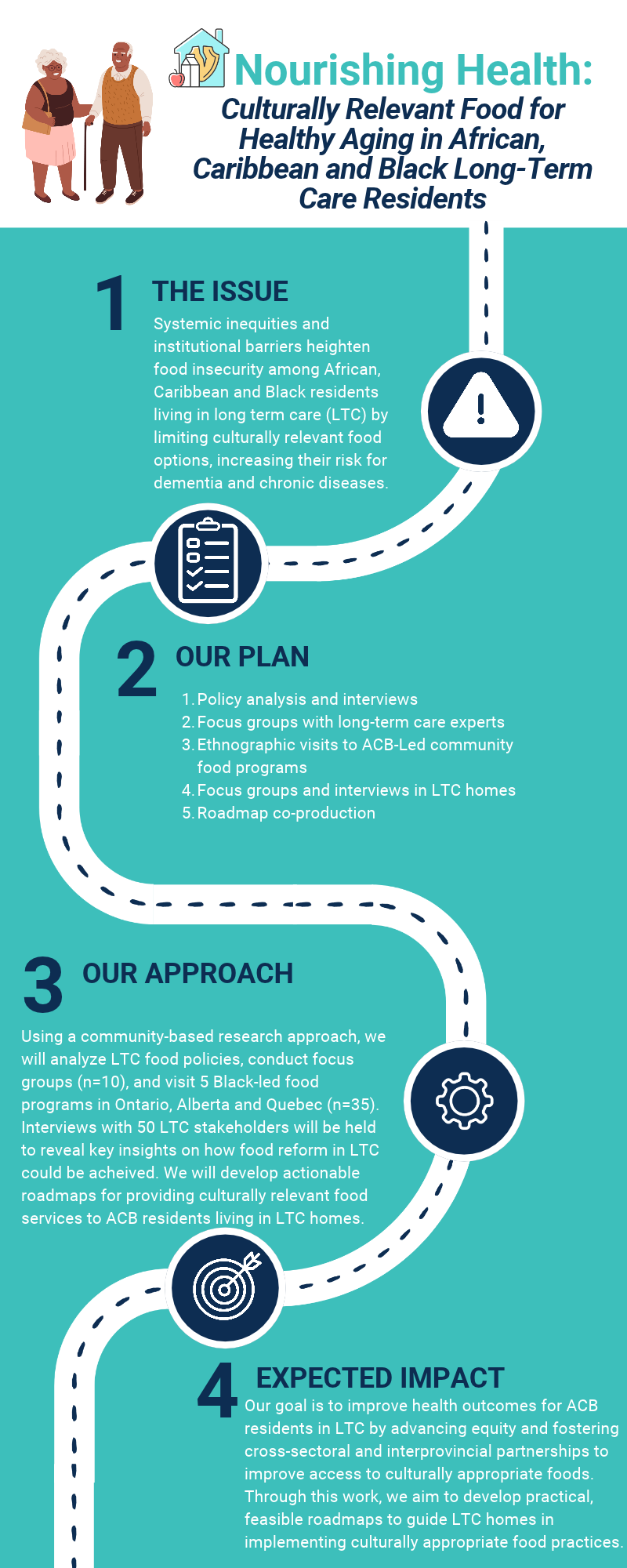
Co-designing roadmaps for promoting culturally relevant food in long-term care homes in partnership with community food programs to address modifiable risk factors for poor health in the African, Caribbean, and Black population in Canada
funding
Canadian Institutes of Health Research (CIHR), Project Grant (2025-28)
Canadian Institutes of Health Research (CIHR), Catalyst Grant (2025)
Research Team
Project Co-Lead: Mwali-Nachishali Muray mmuray@uottawa.ca
Project Co-Lead: Krystal Kehoe MacLeod kmacleod@bruyere.org
Research Coordinator: Eunice Hammond ehammond@bruyere.org
About
Imagine that you have just entered long-term care (LTC). You are older, frail, and wanted to remain at home, but your family said it was time to move. This LTC home does not feel like your home. It has been a few weeks and you have tried to adjust, but things are hard, especially at mealtimes. You used to savour mealtimes and linger at your table because of good conversations shared over satisfying meals that filled your soul as much as your belly. Instead, the meals showing up on your tray are awful. None of the food on your plate brings you the sense of familiar comfort you wish for. You ask your care providers if there are other options and you list examples of foods you like to eat – cassava leaves, fufu, goat and gizzard – foods that you used to eat daily. But you are told that your new home does not serve those foods, that you need to eat to be healthy and hydrated, and that the foods that have been provided are good for you. You wonder how these foods can be good options for you, when you do not like them, they do not make you want to eat, and they do not reflect your cultural preferences. Yet these foods show up on your plate daily. This is the lived experience of many African, Caribbean, and Black (ACB) LTC residents in Canada. Food as meaning, memories, and comfort is lacking in LTC as ACB residents are given a western diet. There is a major gap in understanding how systematically denying traditional and cultural foods to ACB LTC residents is a form of oppression and racism.
newsletters
Presentations
Muray M, Hammond E, Kehoe MacLeod K. (May 27-29, 2026.). Food for wellness: Lessons from policy and community programs to advance culturally relevant care for African, Caribbean, and Black residents in long-term care. National Black Mental Health Conference. Ottawa, Ontario. Oral presentation.
Hammond E, Muray M, Kehoe MacLeod K. (Mar 23-25, 2026). Enhancing person-centred care through cultural foods: Policy and community insights. Together We Care Convention and Trade Show. Toronto, Ontario. Oral presentation.
Publications
Kehoe MacLeod K, Hammond E, Wicks V, Beogo I, Cortbaoui P, Crisp R, Dort J, Dueck C, Fernandez M, Giroux I, Jessri M, Kamara I, Kapfunde D, Li S, Neufeld H, Otoadese D, Peck S, Reed B, Sinha S, Muray M. (2026 May). Co-designing roadmaps for promoting culturally relevant food in long-term care homes for the African, Caribbean and Black population in Canada: A multi-method, participatory action research study protocol. BMC Nutrition. 12(1):113. doi: 10.1186/s40795-026-01331-2.